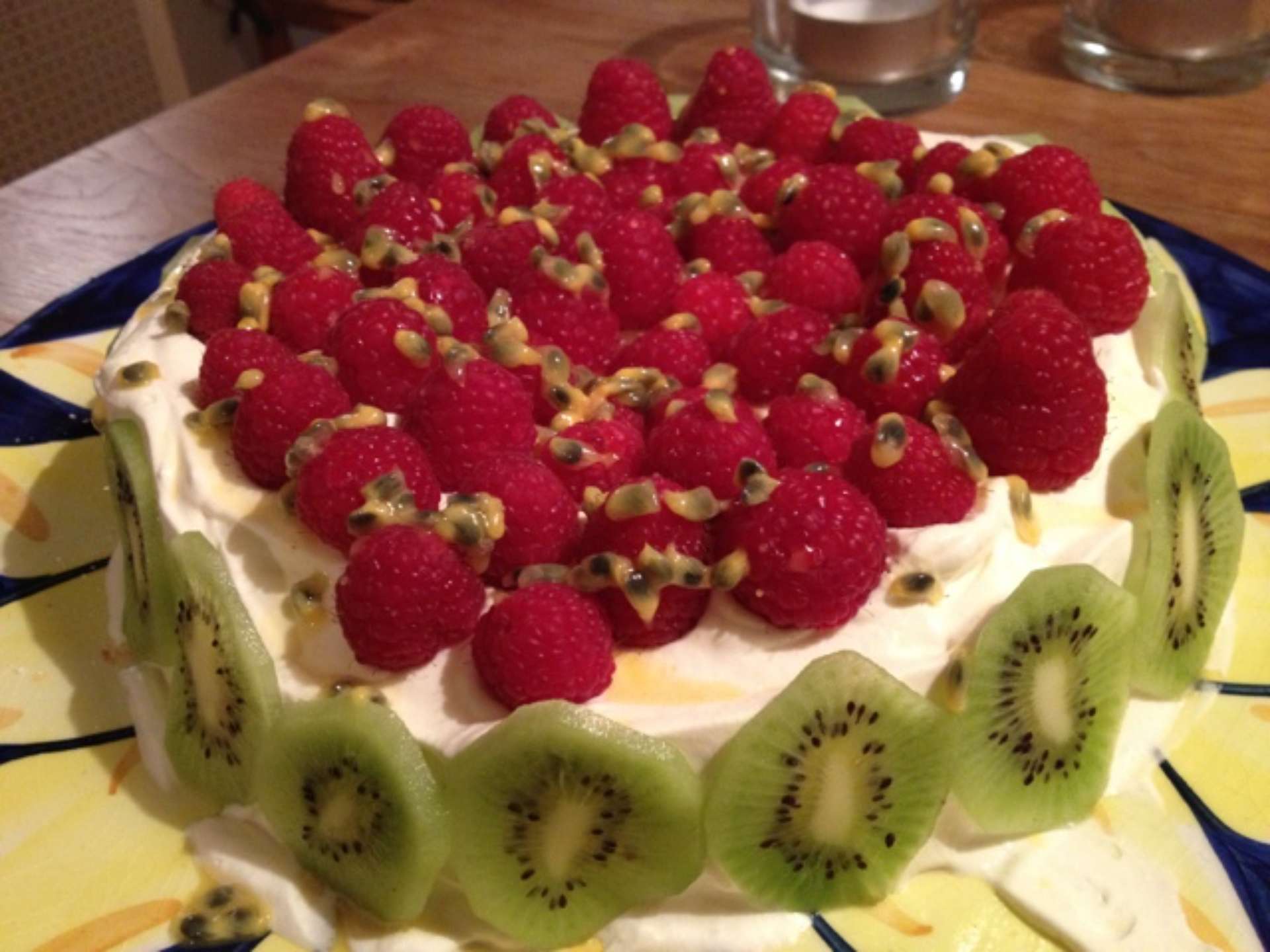
What a great choice for a birthday cake
Pavlova
Australia and New Zealand can continue to argue about its origins, and they will. But none the less the public perception and the general expectations of a pavlova has changed over the pas 30 years or so. The humble birthday pavlova as we knew it growing up has become an international menu success.
a standard in every pastry chefs repertoire from cafe's to fine dining.
The recipe has been tweaked and changed by one and all, often turned into an individual dessert and dried out into a meringue.
For me the pavlova is a great birthday or special occasion cake, and the occasion doesn't need to be so special either, so don't hold back. Pavlova has a tendency to brings out the cookie monster in many of us.
The selection of fruit is up to the individual taste, one can argue that the further north you are "in Australia" the more tropical the fruit selection is. For me, from the south passionfruit and berries are a must.
A night in the fridge wont deter the backyard connoisseur either.
I believe Pavlova should be pronounced with its distinct Australian "New Zealand" slow 3 syllable drawl than by the refined and correct Russian pronouncing of Anna Pavlovas surname. In both Australia and New Zealand its more commonly called "Pav".
The following recipe is for a simple somewhat more traditionally garnished "pav".
Pavlova
150ml egg whites, ca 4 egg
220g caster sugar
2 dsp corn starch
2 tsp vineger
1 tsp vanilla essence or vanilla sugar
3 dl whipping cream
Fruit for garnishing
method:
• Set the oven at 150°
• Whisk the egg whites to a hard froth.
• Whisk in the sugar, small amounts at a time, continue to whisk until all the sugar has melted and the mix is stiff.
• Add the corn starch and vinegar, whisk in.
• On to a prepared baking sheet form into an 18cm cake.
• Reduce the heat to 120 and bake for 1 hour 20 minutes.
• Turn the oven off and allow to stand overnight, in the cooling oven.
• Whisk the cream, garnish pavlova with cream and cut fruit